 English
 عربى
عربى Español


Content
- 1 What NCR Paper Is and Where the Name Comes From
- 2 The Chemistry Behind How NCR Paper Works
- 3 The Three Types of NCR Paper Sheets and How They Work Together
- 4 Common Colors and How to Identify NCR Sheet Position
- 5 Primary Industries and Applications That Rely on NCR Paper
- 6 Printing on NCR Paper: What Works and What to Avoid
- 7 Storage, Handling, and Longevity of NCR Paper
- 8 Environmental Considerations and Modern NCR Paper Formulations
What NCR Paper Is and Where the Name Comes From
NCR paper stands for No Carbon Required paper, a type of chemically coated writing paper that transfers handwritten or mechanically applied impressions from one sheet to the sheets beneath it without the need for traditional carbon paper interleaving. The name itself tells the story: before NCR paper was developed, making duplicate or triplicate copies of a handwritten document required placing sheets of carbon paper — a thin sheet coated on one side with a carbon-based pigment — between each copy sheet. The pressure of writing transferred carbon pigment to the sheet below, creating a copy. NCR paper made this messy, inconvenient intermediate layer obsolete by embedding the copy mechanism within the paper itself through a sophisticated microencapsulation chemistry.
The technology was invented by chemists Barry Green and Lowell Schleicher at NCR Corporation (National Cash Register Company) in the late 1940s and early 1950s, with the first commercial products reaching the market around 1954. NCR Corporation held the original patents and manufactured the paper under the "NCR Paper" brand name, which became so widely recognized that it is now used generically to describe all carbonless copy paper products regardless of manufacturer — much like how "Kleenex" is used generically for facial tissues. Today, NCR paper is manufactured by dozens of paper mills worldwide and remains a staple in business form printing, receipt production, invoicing, and multi-copy documentation across virtually every industry that requires simultaneous duplicate records.
The Chemistry Behind How NCR Paper Works
The functionality of NCR paper relies on a reaction between two chemical components that are kept physically separated until writing pressure brings them into contact. Understanding this chemistry explains why NCR paper produces clean, legible copies without smudging, why the copies appear only where pressure is applied, and why the color development is essentially instantaneous.
The first component is a colorless dye precursor — typically a leuco dye such as crystal violet lactone (CVL) or a fluorane compound — encapsulated in microscopic gelatin or urea-formaldehyde microcapsules coated onto the back surface of the top sheet. These capsules are extremely small, typically 3 to 10 micrometers in diameter, and are distributed uniformly across the coated surface in a density of millions per square centimeter. Under normal handling conditions, the capsules remain intact and the dye precursor within them is colorless and inactive.
The second component is a color developer — an acidic clay mineral such as attapulgite or a phenolic resin — coated onto the top surface of the receiving sheet below. When writing or printing pressure is applied to the top sheet, the microcapsules directly beneath the point of pressure rupture, releasing the liquid dye precursor. This liquid immediately soaks through the paper fibers to the surface of the sheet below and contacts the acidic developer coating, triggering an instantaneous acid-base reaction that converts the colorless leuco dye into its colored form — most commonly a deep blue or black, though red, green, and other colors are produced by varying the dye chemistry. The colored mark appears only where capsules have been broken, producing a precise copy of whatever was written or printed on the top sheet.
The Three Types of NCR Paper Sheets and How They Work Together
NCR paper sets are assembled from three distinct sheet types, each with different coating configurations depending on their position in the collated set. The correct assembly of these sheets in the right sequence is what enables multi-copy forms to function correctly.
- CB (Coated Back) sheet: This is always the top sheet in any NCR set. It has microcapsule coating on its back surface only. The front surface is uncoated and is the writing or printing surface. When pressure is applied to the front, capsules on the back rupture and release dye precursor onto the developer surface of the sheet below.
- CFB (Coated Front and Back) sheet: This is the middle sheet used in sets of three or more copies. It has developer coating on its front surface — which receives the dye from the CB sheet above — and microcapsule coating on its back surface, which in turn transfers a copy to the next sheet below. Multiple CFB sheets can be stacked to create sets of four, five, or more copies, though image quality diminishes slightly with each additional layer due to the progressive reduction in pressure transmission.
- CF (Coated Front) sheet: This is always the bottom sheet in any NCR set. It has developer coating on its front surface to receive the final copy impression from the CFB sheet above it. Its back surface is uncoated because there are no further sheets to receive a copy beneath it.
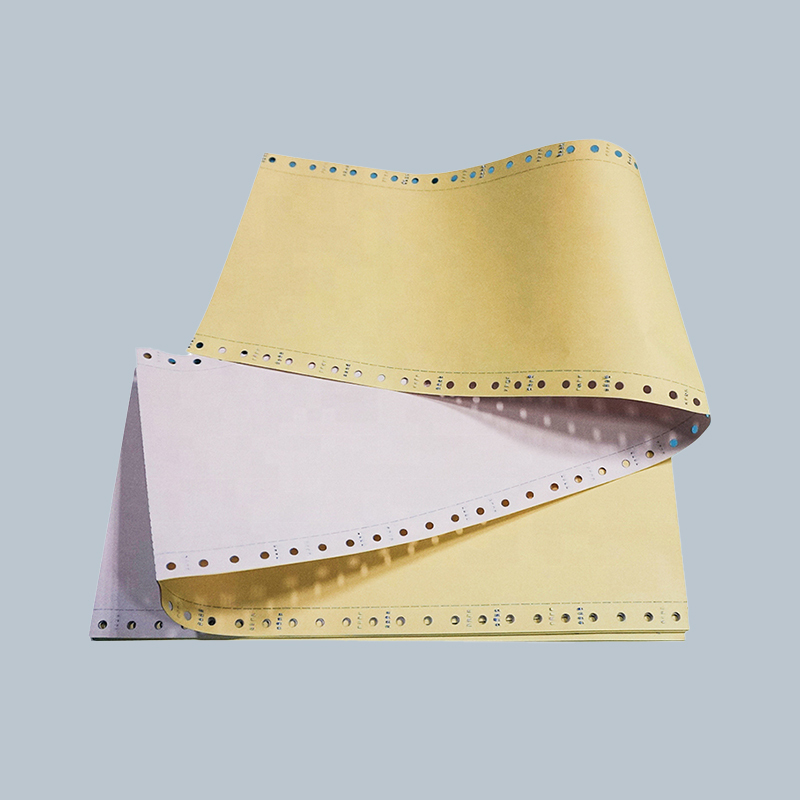
A standard two-part NCR set therefore consists of one CB sheet on top and one CF sheet on the bottom. A three-part set adds one CFB sheet in the middle. This logical layering system means NCR paper sets can be manufactured to any required number of parts by adding the appropriate number of CFB sheets, subject to the practical limit of legibility through multiple layers.
Common Colors and How to Identify NCR Sheet Position
To prevent assembly errors and help users immediately identify which sheet they are handling, NCR paper sets are manufactured in distinguishing colors by convention. While exact color schemes vary by manufacturer and regional market, the following color assignments are widely used in standard business forms:
| Sheet Position | Sheet Type | Typical Color | Common Recipient |
| Top (1st copy) | CB | White | Customer / Client |
| Middle (2nd copy) | CFB | Yellow or Canary | Internal accounting / dispatch |
| Bottom (3rd copy) | CF | Pink or Blue | File / record retention |
Custom color schemes are frequently specified by businesses ordering printed NCR forms in volume, allowing them to match corporate branding, differentiate between form types, or adopt internal routing conventions that are immediately recognizable to staff. The color coding system significantly reduces handling errors in high-volume transaction environments such as freight depots, hospital admissions offices, and point-of-sale operations.
Primary Industries and Applications That Rely on NCR Paper
Despite the widespread digitization of business processes, NCR paper remains in active use across a broad range of industries where multi-copy paper documentation serves practical, legal, or operational purposes that digital alternatives do not yet fully satisfy. The persistence of NCR paper in these sectors reflects its reliability, low cost, portability, and the fact that it requires no power, network connectivity, or electronic device to function.
Logistics, Freight, and Delivery
The logistics and freight industry remains one of the largest consumers of NCR paper worldwide. Consignment notes, delivery receipts, waybills, and proof-of-delivery forms are produced on NCR paper sets so that the driver, the customer, and the depot each receive a simultaneous copy of the same transaction record at the point of delivery. This is particularly important in international freight where customs documentation requires multiple identical copies bearing original signatures — a requirement that a single-sheet document with photocopies cannot satisfy in the same way as NCR-produced simultaneous originals.
Healthcare and Medical Documentation
Hospitals, clinics, pharmacies, and diagnostic laboratories use NCR paper forms for patient admission records, prescription pads, laboratory test request forms, and discharge summaries. Medical NCR forms ensure that the patient, the attending physician, the pharmacy, and the hospital records department all receive identical copies of critical clinical information generated at a single point of entry. In emergency situations where electronic systems may be unavailable or too slow, NCR prescription pads and triage forms allow clinical documentation to continue without interruption.
Construction, Engineering, and Field Services
Site inspection reports, materials delivery dockets, subcontractor work orders, and variation orders in construction projects are routinely produced on NCR paper because the work is performed at locations where printers and computers are impractical. A site foreman completing a daily work record on an NCR pad can give one copy to the client representative, retain one copy for the contractor's records, and send one copy to the head office — all generated simultaneously in the field with a single act of writing.
Printing on NCR Paper: What Works and What to Avoid
NCR paper sets are commercially printed using standard offset lithographic printing, flexographic printing, and laser printing processes — but specific considerations apply to each method to avoid premature activation of the microcapsules or interference with the copy chemistry.
- Offset lithographic printing is the most widely used method for producing pre-printed NCR business forms. The relatively light impression pressure of offset printing does not activate the microcapsules, and UV-cured or conventional inks bond well to both coated and uncoated NCR surfaces. Multi-color form designs, sequential numbering, and perforation can all be incorporated in line.
- Laser printing on NCR paper requires laser-compatible grades specifically formulated to withstand the heat of the fuser unit — typically 150 to 200°C — without premature capsule rupture or developer discoloration. Standard NCR paper is not suitable for laser printing; laser-compatible NCR grades must be specified explicitly when ordering sheets for office laser printer use.
- Inkjet printing on NCR paper is possible but produces less consistent results due to ink absorption variation between the coated and uncoated surfaces of different sheet types. Inkjet-specific NCR grades with modified top coatings are available for this application.
- Impact dot matrix printing was historically the primary method for variable data printing on pre-printed NCR forms in point-of-sale and logistics applications. The pin impact mechanism is ideally suited to activating NCR capsules, producing clear copies through multi-part sets with a single printing pass.
Storage, Handling, and Longevity of NCR Paper
Correct storage of NCR paper is essential to maintaining its copying performance and preventing premature activation or degradation of the chemical coatings. NCR paper should be stored flat in its original sealed packaging in a cool, dry environment with temperature between 15°C and 25°C and relative humidity between 45% and 65%. Exposure to excessive heat — above 40°C — can cause the microcapsules on the CB coating to rupture spontaneously, producing background staining on the CF and CFB surfaces beneath without any writing having occurred. High humidity softens the encapsulation material and can cause capsule coalescence that reduces copy sharpness.
NCR paper stored under recommended conditions maintains its copying performance for five years or more from the date of manufacture. Once completed NCR copies have been produced, the developed color image on the CF and CFB surfaces is chemically stable under normal storage conditions — protected from prolonged direct sunlight and heat — for several years, making it adequate for most business record retention requirements. However, for long-term archival storage of legally significant documents, photocopying or scanning the NCR copies onto plain paper or digital formats is advisable to ensure permanent legibility regardless of any future degradation of the chemical image.
Environmental Considerations and Modern NCR Paper Formulations
Early NCR paper formulations used phenolic resins as the color developer component, and some early microencapsulation systems used materials that raised environmental and occupational health concerns. Modern NCR paper production has largely addressed these issues through reformulation with mineral clay developers — primarily kaolin and attapulgite — that are environmentally benign, and through the development of microencapsulation systems using food-grade or pharmaceutical-grade materials that pose no inhalation or dermal hazard under normal handling conditions.
NCR paper is recyclable through standard paper recycling streams in most markets. The chemical coatings represent a very small fraction of the total paper weight and do not interfere significantly with the pulping and repulping process used in paper recycling mills. Several major NCR paper manufacturers have achieved certification for recycled content in their products and have reduced the environmental footprint of the coating chemicals through lifecycle assessment programs. For businesses seeking to balance the practical necessity of multi-copy paper documentation with environmental responsibility, specifying FSC-certified NCR paper from manufacturers with verified environmental credentials provides a practical path to sustainable procurement without compromising the operational functionality that NCR paper uniquely provides.